FAA Airframe and Powerplant Intro training
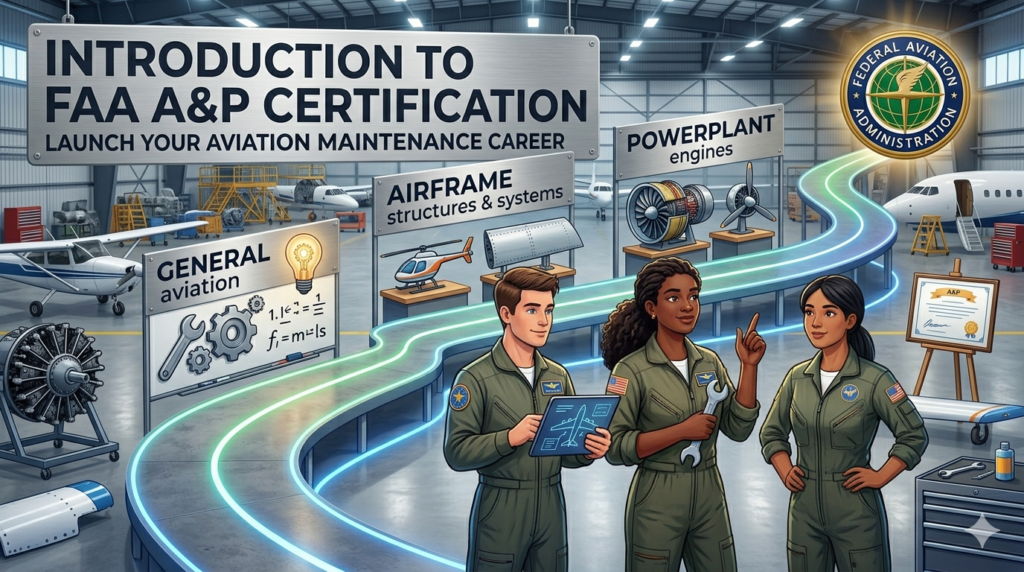
Launch Your Aviation Career: Introduction to the FAA A&P Certification
Course Overview Are you ready to turn your passion for aviation into a high-paying, high-demand career? The Federal Aviation Administration (FAA) Airframe and Powerplant (A&P) mechanic certificate is your golden ticket to the aerospace industry. Whether you want to work on commercial airliners, general aviation aircraft, or cutting-edge helicopters, your journey starts here.
This introductory course is designed to give you a clear, comprehensive roadmap of what it takes to become a certified Aviation Maintenance Technician (AMT). We will demystify the FAA examination process and provide a high-level summary of the critical subjects you will need to master to successfully pass your written, oral, and practical exams.
Who Should Take This Course?
- Aviation enthusiasts exploring a hands-on career as an aircraft mechanic.
- Future AMT students looking for a head start before enrolling in an FAA-approved Part 147 maintenance school.
- Military veterans preparing to transition their technical experience into the civilian aviation sector.
What You Will Learn To earn your A&P license, the FAA requires you to demonstrate proficiency across three core areas. This course will introduce you to the foundational concepts of each section:
1. General Aviation Subjects This section forms the foundation of all aircraft maintenance. We will preview the essential science, math, and regulations that keep aircraft flying safely, including:
- Basic Electricity: Understanding circuits, voltage, and aircraft electrical systems.
- Aircraft Weight and Balance: The critical calculations required for safe flight operations.
- Aviation Physics & Math: Applying fundamental formulas to real-world mechanical problems.
- FAA Regulations & Publications: Navigating the legal framework of aircraft maintenance, compliance, and proper logbook entries.
- Materials and Processes: Identifying aviation-grade hardware, metals, and non-destructive testing (NDT) methods.
2. Airframe Structures and Systems A dive into the body, exterior, and internal operational systems of the aircraft. Topics overviewed include:
- Structural Repair: Introduction to sheet metal, riveting, and modern composite materials.
- Aircraft Systems: A high-level look at hydraulics, pneumatics, and cabin environmental control systems.
- Assembly and Rigging: Understanding flight controls, cables, and aerodynamic stability.
- Landing Gear Systems: Inspections and maintenance of wheels, brakes, and tires.
3. Powerplant (Engine) Systems The heartbeat of the aircraft. We will cover what you need to know about aircraft engines and their supporting components, including:
- Reciprocating Engines: The mechanics, inspection, and overhaul of piston engines used in general aviation.
- Turbine Engines: An introduction to the operation of jet engines, turboprops, and turbofans.
- Engine Systems: Fuel metering, ignition, lubrication, and exhaust systems.
- Propellers: Fundamentals of propeller theory, maintenance, and operation.
Your Flight Plan to Success Stop dreaming about a career in aviation and start building it. By the end of this short introductory course, you will know exactly what the FAA expects of you and feel completely confident taking your first steps toward earning your A&P license.